
Green Pepper
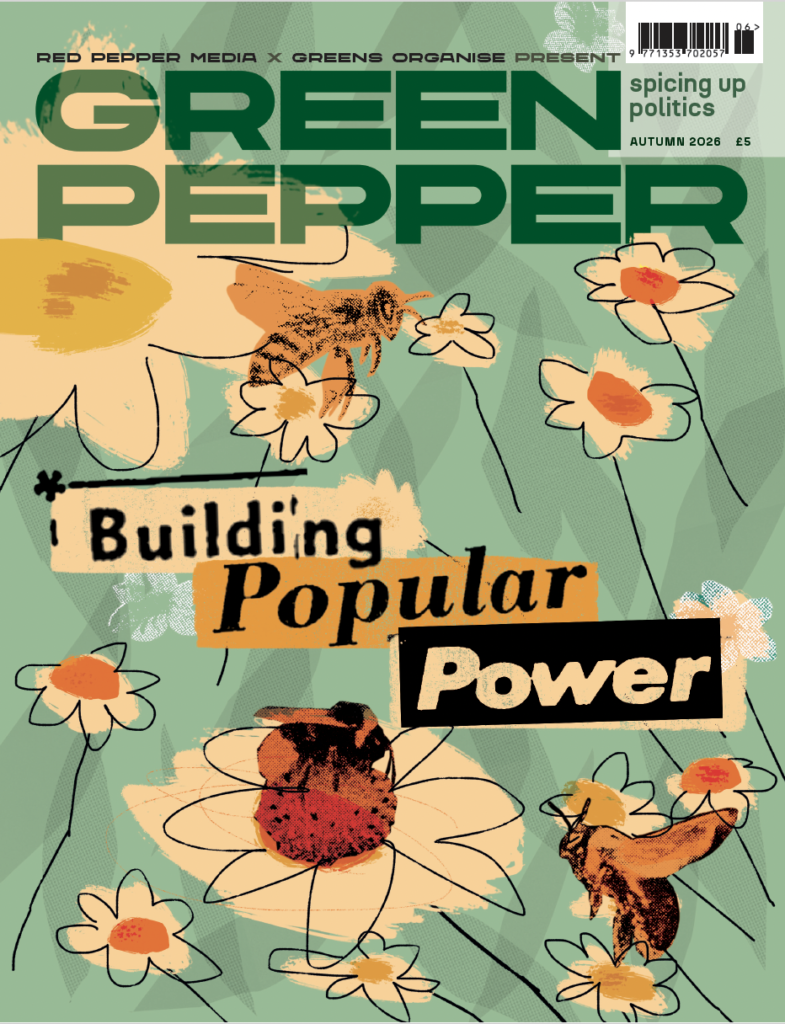
Red Pepper Media and Greens Organise present a special issue of Red Pepper magazine, launching Friday 2nd October 2026 at Green Party conference.
FREE copy for Greens Organise members if collected at conference.
Otherwise available to buy at the Greens Organise stall.
Building popular power
- Keir Milburn and Bertie Russell on building institutions of popular power against capitalism
- Hilary Wainwright speaks to Liam Shrivastava and Zoë Garbett about how Green mayors can shift power
- Robert Magowan asks what it would mean for the Green Party to be ecosocialist
- Sophia Brown on the fight against austerity
- Gargi Bhattacharyya on a necessary new approach to anti-racism
- International coverage: Colombia’s left-right split; popular power in Uruguay and water apartheid in the West Bank
- Interview with musician André Jahnoi
- Red Pepper regulars The Spark, Key Words, book reviews, previews and more!
Can’t get to conference?
Green Pepper will also be available in some bookshops.
Or if you’re a Red Pepper subscriber you will receive a copy in the post.
‘Green Pepper’ is a one-off special edition produced as a collaboration between Red Pepper Media (RPM) and Greens Organise, around our shared interest in ecosocialism. The project is spearheaded by the RPM editorial collective and James O’Nions, a former Red Pepper editor and now Greens Organise steering group member. The publication is a ‘bonus’ issue for RPM subscribers, reflecting their investment in movement-building, and an introduction to Red Pepper for GO members and emerging ecosocialists!
For a politics of life
Green Pepper editorial • James O’Nions
As the UK emerges from a summer of drought and wildfires into an unseasonably warm autumn, the effects of climate breakdown are growing around the world. Beyond devastating, headline-grabbing weather events, an age of global food and water shortages is fast approaching.
Why have we been unable to stop this slow motion disaster? Many factors have surely played a role, but at root the disaster is being driven by an economic system based on profit maximisation. Fossil capital simply makes up too big a fraction of the economy; oil in particular makes the economic world go round. But the problem is bigger: from the global beef industry’s methane emissions to the water and energy demands of data centres, our desires have been structured to make some people very rich.
Knowing this is one thing, changing it is another. In Colombia, an ecosocialist party advocating a ‘politics of life’ has been narrowly defeated by a far-right millionaire backed by Trump (page 20). Globally, a capitalist class determined to hang onto their wealth are increasingly turning to far-right populists able to articulate a reactionary defence of corporate power which enough people will vote for.
Nevertheless, as the sudden growth of the Green Party of England and Wales has shown, an ecological left populism also holds potential. Zack Polanski’s eco-populist project was knitted together from the cost of living crisis, disgust at the genocide in Palestine, and fear of climate breakdown. That the party won a swathe of inner-London councils in May (page 10), along with others like Norwich, has opened up important strategic questions about how to use political power while hemmed in by austerity. Keir Milburn and Bertie Russell’s argument (page 15) for creating community-run space beyond the capitalist economy is particularly important in this context.
If we are to fight capitalism’s deathgrip on humanity and the planet, building popular power is essential, through mass campaigns like opposition to data centres in Scotland, and organising in the mould of Rochdale tenants’ rights groups. But we also need an ecosocialist political horizon, with winning power a necessary tool for social and ecological transition – on which the future of our lifeworld depends.